Updated: March 24, 2026
The conflict remains active, and there is no confirmed breakthrough in U.S.–Iran diplomacy
Military operations continue even as both sides send conflicting political signals.
The most important fact at the moment is that the crisis is still an active conflict, not a settled diplomatic standoff. Reuters reports that the United States plans to continue strikes on Iranian military-related targets, while a temporary pause applies only to attacks on energy infrastructure, not to broader military objectives. At the same time, President Donald Trump has described contacts as “productive,” but Iranian officials have publicly denied that any real direct negotiations with Washington are taking place. That contradiction is one of the clearest signs that diplomacy remains uncertain and fragile.
In practical terms, this means the situation is not moving toward peace in a straightforward way. Instead, it combines ongoing military pressure with uncertain diplomatic messaging, and neither side is presenting a fully aligned public narrative. Reuters and AP both indicate that outside intermediaries may be involved, but there is still no verified evidence of a formal U.S.–Iran agreement or immediate ceasefire.
Iran has hardened its position instead of softening it
Tehran is reportedly demanding major concessions before any real talks could move forward.
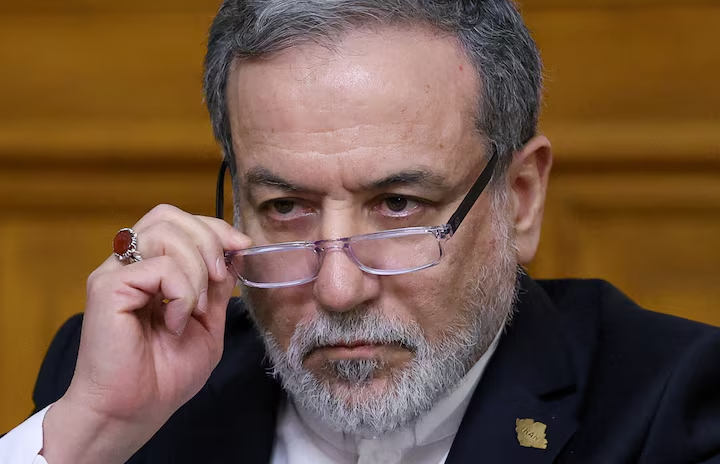
According to Reuters, Iran has toughened its negotiating stance. Senior sources cited in the reporting say Tehran now wants several major conditions met before meaningful talks can proceed: a formal end to the war, guarantees against future attacks, compensation for wartime damage, and no restrictions on its ballistic missile program. Reuters also reports that the Islamic Revolutionary Guard Corps has increased its influence over decision-making, making compromise even harder.
This matters because it reduces the likelihood of a quick diplomatic settlement. A government that raises its demands in the middle of war is signaling that it believes military resilience, regional leverage, or political pressure may improve its bargaining power. Reuters’ reporting suggests that Iran’s internal political structure, wartime pressures, and distrust of U.S. and Israeli intentions are all contributing to a more rigid line.
Pakistan has emerged as a possible mediator
One of the most concrete diplomatic tracks now runs through Islamabad.
A major diplomatic development is Pakistan’s stated willingness to host peace talks aimed at ending the war. Reuters and AP both report that Pakistani Prime Minister Shehbaz Sharif has positioned Pakistan as a possible facilitator between Iran and the United States. AP also notes that other countries, including China, Egypt, Jordan, and Oman, are calling for urgent diplomacy and de-escalation.
This is significant because neutral or semi-neutral intermediaries often become essential when direct talks are politically impossible. However, the same reporting makes clear that mediation is not the same as progress. Iran still denies real direct negotiations, and its stated demands remain high. So while Pakistan may be a channel for communication, that does not yet mean a peace process is securely underway.
The confrontation is no longer only about Iran and the United States
The conflict has spread across the region, involving Israel, Gulf states, and wider security risks.
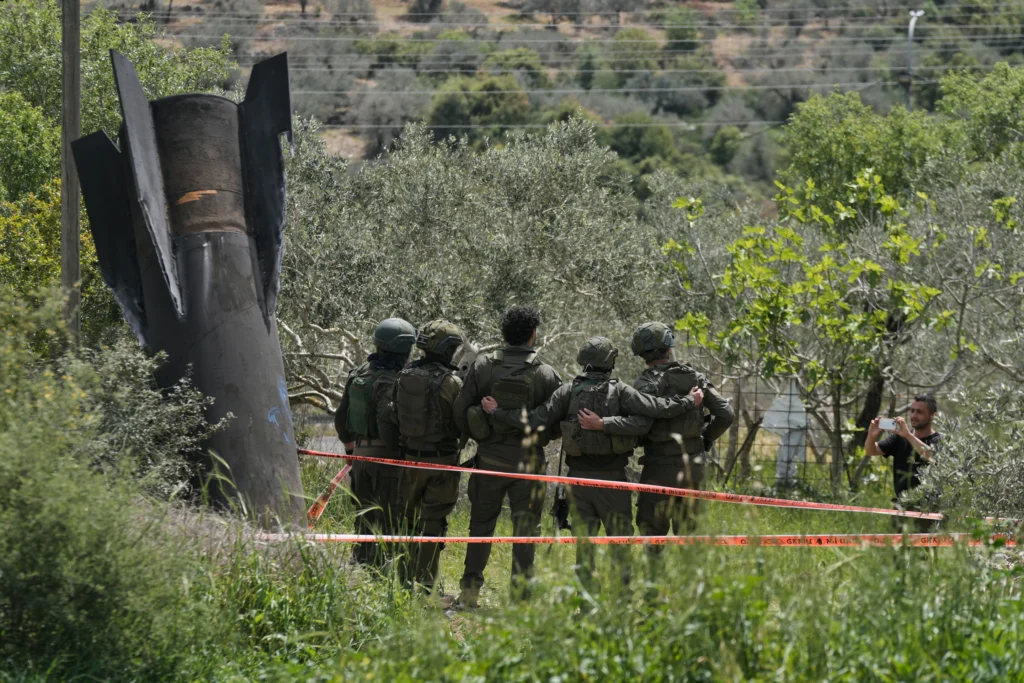
AP reports that airstrikes and missile attacks are affecting a broader Middle Eastern theater. Iran has launched attacks that reached Israeli territory and parts of the Gulf region, while Israel has struck targets in Iran and Hezbollah-linked positions in Lebanon. The reporting describes civilian and military casualties, damage to infrastructure, and growing regional instability.
That broader geography is crucial. Once a conflict spreads into multiple countries and strategic corridors, it becomes harder to contain. It also increases the risk of miscalculation, proxy escalation, or accidental widening of the war. AP’s coverage shows that the current crisis has already moved beyond a narrow bilateral framework and now threatens regional balance more generally.
The Strait of Hormuz has become one of the central pressure points
Global oil flows and maritime security are now directly tied to the crisis.
Reuters reports that the Strait of Hormuz remains at the center of the conflict. This waterway is one of the most important routes in the world for oil and liquefied natural gas shipments. Reuters says Brent crude rose above $104 per barrel, while analysts warned that prices could climb further if disruption continues. The report also describes the strait as effectively closed amid the current war conditions.
This is not only a regional issue. Any sustained disruption in Hormuz immediately affects international energy prices, shipping confidence, insurance costs, and inflation risks in countries far from the Middle East. That is why the Iran–U.S. crisis is being watched not merely as a military confrontation, but as a global economic shock risk.
Energy infrastructure is increasingly exposed
Oil and gas facilities across the Middle East have become both targets and leverage points.
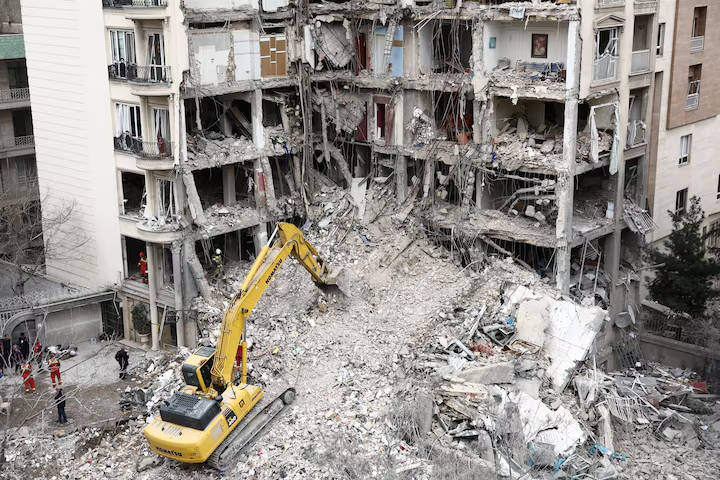
Reuters reported on March 20 that the conflict has already affected major oil and gas infrastructure in the region. The article describes strikes on Iranian facilities as well as retaliatory pressure on Gulf energy assets, including damage or shutdowns affecting refineries, LNG sites, and export facilities. Reuters notes that some regional producers cut output or declared force majeure, and the International Energy Agency released reserves in response to the scale of disruption.
This matters because attacks on energy infrastructure do two things at once: they weaken the targeted state economically, and they send a warning to global markets. In other words, infrastructure is not just collateral damage here; it is part of the strategic contest itself.
Washington is still trying to persuade skeptical allies
The U.S. position has not been fully embraced by key Western partners.
AP reports that Secretary of State Marco Rubio is traveling to France for a G7 foreign ministers meeting near Versailles, with the purpose of presenting and defending the U.S. strategy on Iran. AP says many allies remain skeptical and that most G7 members have shown limited support for direct military involvement.
This is an important diplomatic signal. If the United States cannot secure broad allied backing, its strategy may become harder to sustain politically and militarily over time. Even when allies agree on the dangers posed by escalation, they may disagree on the methods used to respond. AP’s reporting suggests that this division is already visible.
The economic consequences are now visible inside the United States
The war is affecting business activity, inflation risks, and market confidence.
Reuters reports that U.S. business activity fell to an 11-month low in March 2026, according to an S&P Global survey, with higher energy prices and uncertainty tied to the war contributing to inflation concerns. The same Reuters report says oil prices have surged sharply and gasoline prices have risen, creating broader pressure on consumers and businesses.
That means the costs of the conflict are no longer abstract. They are appearing in economic data, labor-market caution, consumer prices, and broader market expectations. Even if the fighting remains geographically concentrated in the Middle East, its impact is already traveling through energy and financial systems into the American economy.
The battlefield and the negotiation table are influencing each other in real time
Each new strike appears to alter the diplomatic atmosphere rather than pause it.
One of the clearest patterns across the latest Reuters and AP reporting is that military escalation and diplomacy are happening simultaneously, not separately. Strikes, missile launches, and threats against strategic infrastructure are shaping the tone and terms of possible talks. Iran’s harder demands, the U.S. continuation of military pressure, and outside mediation attempts are all unfolding at once.
This often makes peace efforts unstable. In conflicts like this, negotiations do not happen in a calm environment; they happen while each side is trying to improve its leverage. That appears to be exactly the current pattern. The result is a situation in which diplomacy is visible, but not yet reliable.
The overall picture is one of escalation, not resolution
The latest credible reporting does not support the idea of an imminent settlement.
Putting the current evidence together, the most accurate conclusion is that the Iran–U.S. situation in the Middle East remains dangerous, fluid, and unresolved. The United States is still applying military pressure; Iran is publicly denying real direct talks and raising its conditions; regional actors are already affected; energy markets are under strain; and mediation efforts are active but uncertain. Reuters and AP do not currently show a confirmed breakthrough toward a durable ceasefire or comprehensive agreement.