Përditësuar: Prill 2026
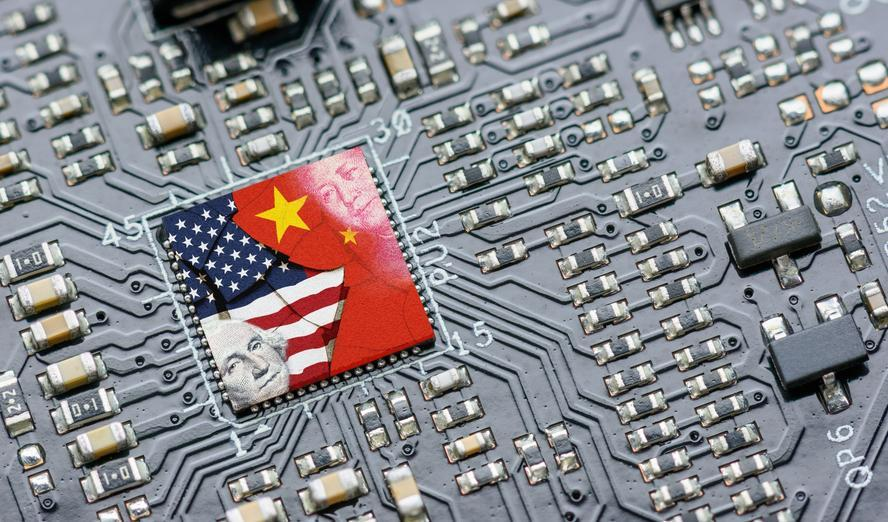
The technological rivalry between the United States and China has evolved into one of the defining dynamics of the 21st century. Unlike traditional geopolitical competition, this confrontation is increasingly structured around control of critical technologies, including artificial intelligence, semiconductor manufacturing, quantum computing, and advanced telecommunications. The implications extend far beyond economic performance, influencing national security, global supply chains, and the future architecture of innovation.
The Strategic Context of Technological Competition
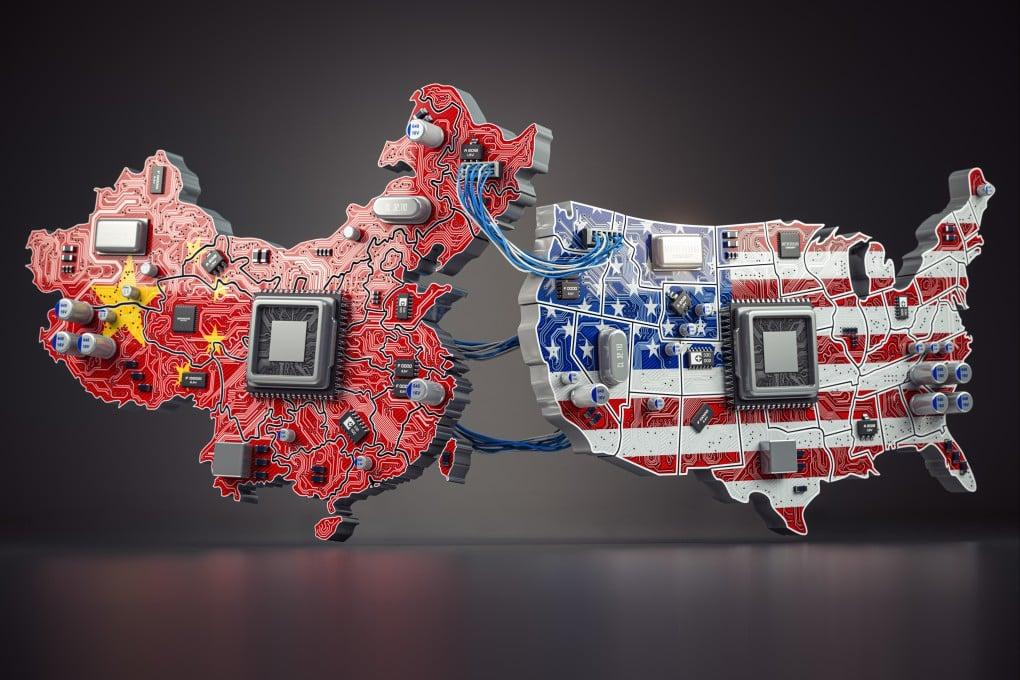
At its core, the U.S.–China technological competition reflects a transition from globalization toward technological sovereignty. Both states are actively pursuing policies designed to secure dominance in key sectors. The United States has focused on restricting access to advanced semiconductor technologies, particularly those required for high-performance computing and artificial intelligence. China, in turn, has accelerated domestic innovation through large-scale investments and state-backed industrial strategies. This competition is not merely economic but systemic. Technological leadership increasingly determines military capability, economic resilience, and political influence. As a result, innovation ecosystems have become strategic assets.
Artificial Intelligence: Algorithmic Power and Data-Driven Systems
Artificial intelligence represents one of the most critical domains of competition. AI systems are fundamentally based on models derived from Machine Learning, particularly deep neural networks. These models require three essential components: large datasets, computational power, and optimized algorithms.
The United States maintains a strong position in foundational AI research, supported by leading technology firms and academic institutions. Meanwhile, China has leveraged its large population and extensive data generation to develop highly scalable AI applications, particularly in computer vision and urban systems.
Nga një perspektivë shkencore, IA moderne mbështetet në proceset e optimizimit matematikor, siç është zbritja gradient, për të minimizuar funksionet e gabimit brenda hapësirave të parametrave me dimensione të larta. Shkalla në rritje e modeleve – shpesh që përmbajnë miliarda parametra – ka intensifikuar kërkesën për pajisje të përparuara, duke e lidhur zhvillimin e IA-së drejtpërdrejt me inovacionin e gjysmëpërçuesve.
Gjysmëpërçuesit: Themeli Fizik i Energjisë Dixhitale
Semiconductors form the backbone of all modern computing systems. The production of advanced chips depends on highly sophisticated fabrication techniques, including extreme ultraviolet (EUV) lithography, which enables transistor features at the nanometer scale.
The United States and its allies currently dominate the most advanced stages of semiconductor design and manufacturing equipment. In contrast, China is investing heavily in domestic production capabilities to reduce dependency on foreign technologies.
Scientifically, semiconductor functionality is based on the controlled manipulation of charge carriers within materials such as silicon. By doping these materials with impurities, engineers create regions of varying electrical conductivity, forming transistors—the fundamental building blocks of digital circuits. The continued miniaturization of these components, often described by Moore’s Law, has enabled exponential growth in computational power.
However, as transistor sizes approach physical limits, new challenges emerge, including quantum tunneling and heat dissipation. These constraints are driving research into alternative architectures, such as three-dimensional chip designs and novel materials.
Quantum Computing: Beyond Classical Limits
Another critical frontier is Quantum Computing, which aims to exploit principles such as superposition and entanglement to perform computations beyond the capabilities of classical systems.
In quantum systems, information is encoded in qubits rather than binary bits. Unlike classical bits, which exist in states of 0 or 1, qubits can exist in multiple states simultaneously. This property allows quantum computers to process vast combinations of inputs in parallel, potentially solving complex problems in cryptography, material science, and optimization.
Both the United States and China are investing heavily in quantum research. While practical, large-scale quantum computers remain under development, progress in this field could redefine computational boundaries and disrupt existing encryption systems.
5G and Communication Infrastructure
Telecommunications infrastructure represents another dimension of competition, particularly in the deployment of 5G networks. These systems enable high-speed data transmission, low latency, and the integration of connected devices within the Internet of Things (IoT).
China has taken a leading role in the global expansion of 5G infrastructure, while the United States has focused on securing networks and promoting alternative technological ecosystems. From a technical standpoint, 5G relies on advanced signal processing, higher-frequency spectrum bands, and beamforming techniques to increase network efficiency and capacity.
Scientific and Technological Implications
The technological competition between the United States and China is not a zero-sum game but a dynamic system that accelerates innovation globally. However, it also introduces fragmentation risks, as competing standards and supply chains may reduce interoperability.
From a scientific perspective, this rivalry is driving rapid advancements across multiple disciplines. Increased funding, interdisciplinary collaboration, and accelerated research cycles are contributing to breakthroughs that may have long-term benefits for society.
At the same time, ethical considerations—particularly in AI and surveillance technologies—are becoming increasingly significant. The integration of advanced technologies into governance and security frameworks raises questions about privacy, accountability, and the societal impact of automation.
Conclusion
The technological competition between the United States and China represents a complex interplay between science, engineering, and geopolitics. It is shaping the trajectory of innovation in critical fields such as artificial intelligence, semiconductors, quantum computing, and telecommunications.
As this competition evolves, its outcome will not be determined solely by technological breakthroughs but by the ability of each system to integrate scientific knowledge, industrial capacity, and strategic vision. In this context, the future of global technological development remains deeply interconnected with the balance of power between these two leading nations.